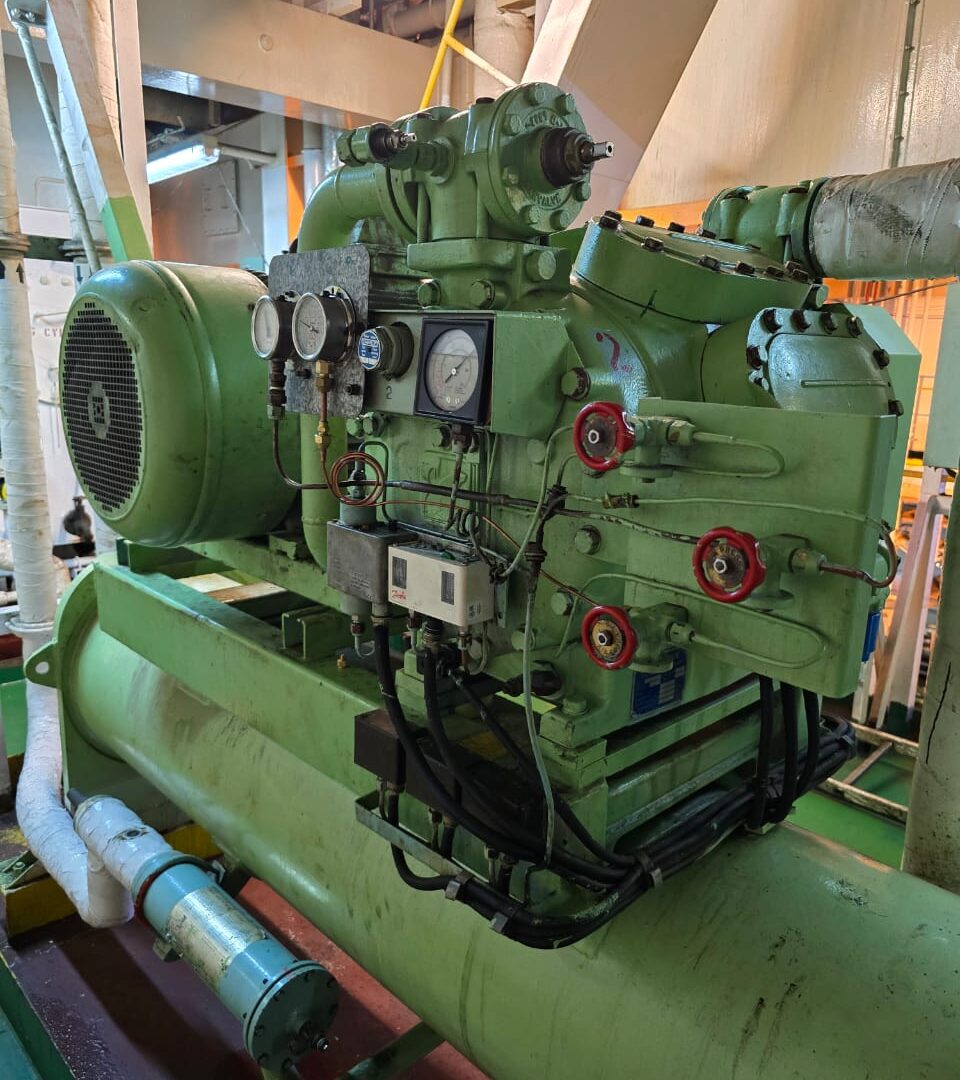
Plenty of vessels calling UAE ports are still operating provision plants and air conditioning
systems on R22. If yours is one of them, it isn’t an emergency — but it is a clock, and it’s worth
understanding exactly what the regulation says rather than what people assume it says.
What Regulation 12 actually says
MARPOL Annex VI, Regulation 12 governs ozone-depleting substances on ships. Two
provisions matter most in practice:
-
New installations are prohibited. Installation of equipment containing
ozone-depleting substances — including HCFCs such as R22 — is prohibited on ships
constructed on or after 1 January 2020. -
Documentation is mandatory. Every ship must maintain a list of
equipment containing ODS, and an ODS Record Book recording each
occasion of servicing, maintenance, repair or disposal affecting that equipment.
What this means for an existing R22 plant
The common misreading is that R22 is simply banned outright and every vessel must convert
immediately. That isn’t what Regulation 12 says. What it creates, for an existing system, is:
- An ongoing documentation obligation — the equipment list and the Record Book, both examinable by Port State Control.
- A ceiling on the plant’s future — it cannot be replaced like-for-like on a newer vessel, and supply of the refrigerant becomes progressively harder and more expensive.
- A cost that grows the longer it’s deferred — both in refrigerant price and in the risk of being forced into the work at the least convenient moment.
Every top-up of an R22 system is another Record Book entry. If a plant is leaking often enough to
need regular charging, the paperwork itself starts making the argument for conversion.
The conversion options
Conversions from legacy R12 and R22 systems typically move to R134a, R407c, R404a or
R417a, depending on the plant, the duty and the temperatures involved. Which one is right
is an engineering decision, not a preference — the wrong choice will run, but it will run badly.
Why a conversion is not a gas change
This is the part that gets underestimated, and it’s where most poor conversions come from. Swapping
the refrigerant is the easy step. The engineering around it is the actual work.
Oil compatibility
R22 systems typically run mineral oil. Most replacement refrigerants require POE or alkylbenzene.
These oils don’t mix, and residual mineral oil left in the system won’t return to the compressor
properly with the new refrigerant. The result is a compressor slowly starving of lubrication while
everything appears normal from outside.
Proper flushing and residual oil management is not optional.
Component compatibility
Seals, gaskets, elastomers, driers and expansion devices may all need changing. Expansion valves
in particular are sized for a specific refrigerant’s properties — leave the original in place and
the system will run at the wrong superheat for the rest of its life.
Capacity and duty
Replacement refrigerants don’t deliver identical capacity at identical conditions. A conversion
that ignores this gives you a plant that holds temperature in mild conditions and can’t cope when
the seawater is warm and the provision rooms are full — which, in the Gulf, is most of the year.
Recovery and disposal
The existing charge must be recovered and disposed of lawfully, and that action recorded. Venting
it is both an offence and a Record Book problem.
What a properly executed conversion covers
- System assessment — condition, capacity, component compatibility, and an honest view on whether conversion is the right answer at all
- Oil changeover — mineral to POE or alkylbenzene, with flushing and residual oil management
- Component changes — expansion devices, seals, gaskets, driers and any material incompatibilities
- Recovery and lawful disposal of the existing charge
- Recharge, leak test and pressure test
- Performance verification — capacity and temperatures checked against the actual duty, not just confirmation that it runs
- Documentation — a full record of the work for the ODS Record Book, the class file and PSC inspection
When conversion isn’t the right call
Sometimes it isn’t. If the compressor is near end of life, the heat exchangers are heavily fouled
or corroded, and the controls are obsolete, spending on a conversion is spending on a machine
that’s leaving anyway. In that case a plant replacement — planned into a docking, not forced by a
breakdown — is the better commercial decision.
Any contractor who recommends conversion without first assessing the plant’s mechanical condition
is guessing with your money.
Timing it sensibly
The best time to do this work is during a scheduled repair period or drydock, when the plant can be
opened up without a sailing date pressing on it. The worst time is after a failure, when you’re
choosing between a rushed job and a delayed departure.
If your vessel is still on R22, the useful question isn’t “when must I?” — it’s “when does it suit
my docking schedule?” Those two answers are usually years apart, and the second one is much
cheaper.
A note on who can do this work
Refrigerant conversion demands both certification and genuine hands-on experience. It is a
relatively small field. When appointing a contractor, ask what they intend to do about the oil,
what they’ll change on the expansion side, and how they’ll verify performance afterwards. Those
three answers separate an engineered conversion from a gas swap.
Planning a conversion, or just weighing it up?
Send us the vessel details, the plant make and the refrigerant in use. We’ll assess your position
honestly — including telling you if conversion isn’t yet the right call.